

“Open Body Posture” For Babies
What Is It & Why Is It Important?
How I Support Open Posture for My Babies
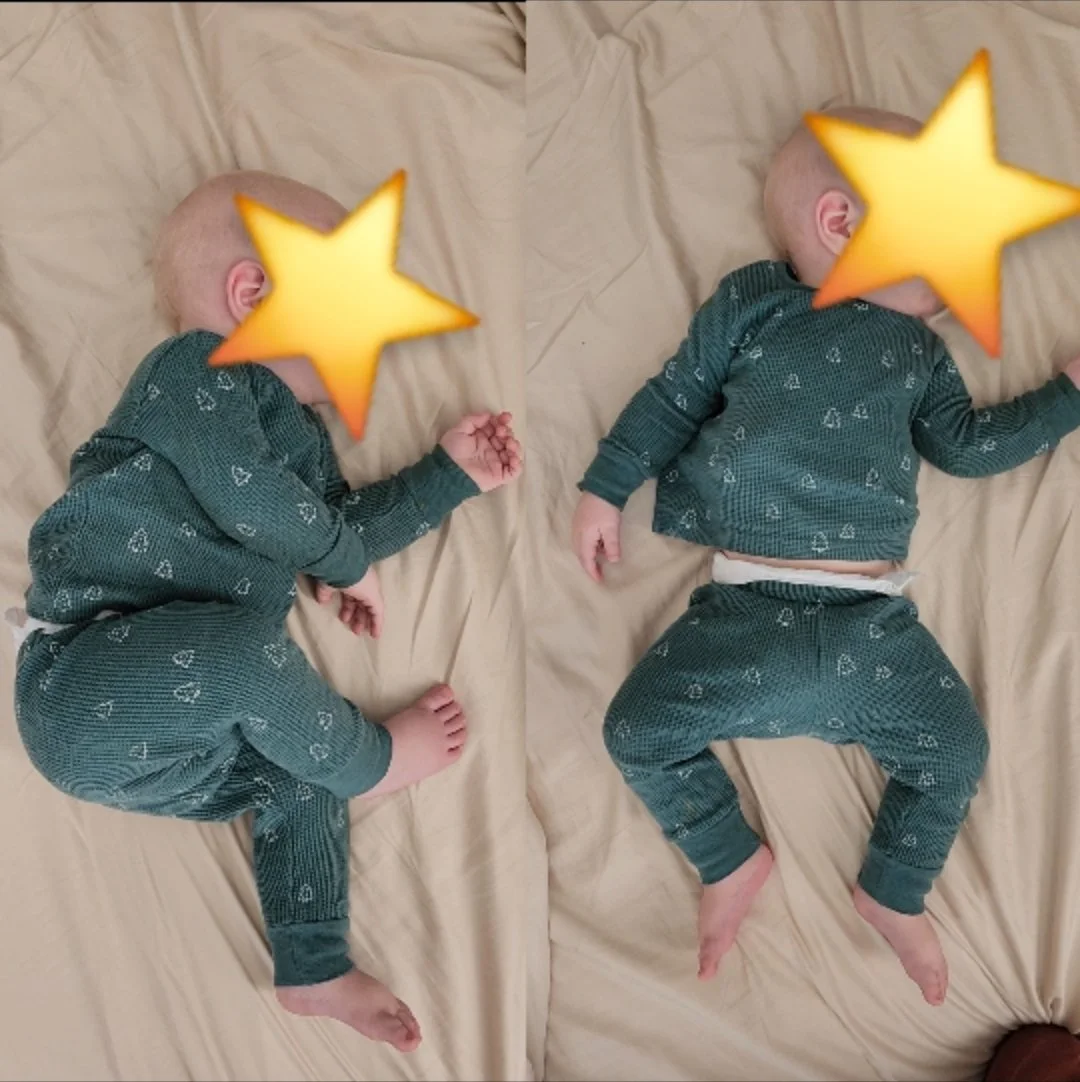
Closed vs. Open Posture
Left Image - “Closed Posture”: Tailbone tucked under, chin down, neck closed, body crunched up in a C shape.
Right Image - “Open Posture”: Open pelvis, tailbone untucked, neck, chest and belly open
I first learned about open posture 5 years ago, when my first baby’s tongue-tie release didn’t resolve her breastfeeding struggles and colic symptoms like I had hoped. Through that process, I learned the importance of getting the right support before and after a tie release for optimal results. I wanted to do everything I could to support her growth and development. I dove down the rabbit hole of oral ties, body tension, fascia, facial and airway development, breathing, nutrition, environment, and posture.
And what do you know?? It’s ALL connected. 🌀
What Is Open Posture?
Open Posture is kind of a fancy way of saying “good posture” but not quite. Instead of the typical “straight line” going from head to toe, standing straight as an arrow with the back straight and shoulders pulled back… Open posture is a way of embracing the natural curves of the spine without collapsing or dumping weight into any one area of the body. This looks like: slight anterior tilt (not dumped forward), slight bend in the knees, open throat, eyes on the horizon, chest expanded upward and out on all sides (not puffed outward).
There is a time and a place for “collapsed” posture. But chronic collapse (or even over-extension) is not what we want long-term. I’m also not referring to the “newborn scrunch”. That is normal.
When I talk about “collapsed posture”, I’m referring to tension patterns or weakness that keep the body in a chronic state of collapse or hyper-extension as a coping mechanism or compensation.
Impact of poor posture by Paris Latka (Bowspring Instructor)
Busting the myth of ‘tucking your tail bone by Paris Latka
Why Is Open Posture Important?
Through what I went through with my daughter, I learned open posture is especially helpful for babies with a history of oral ties because they can also have body tension. Encouraging open posture in babies gives them the space in their body to eat, sleep, and grow to their full potential.
Speaking for my own tongue-tied babies (and myself - diagnosed with a tongue-tie as an adult) it’s very hard to maintain open posture when you have a tongue-tie. It’s like moving around with a rubber band attached from your head to your toes pulling your head forward and your entire body downwards into a collapsed state and causing lots of added pressure. Many tongue-tied adults who opt for a release in adulthood talk about how light they feel in their bodies afterwards. Their posture and range of motion completely changes too!
I saw this transformation with my babies also! Before their tongue-tie release and bodywork, my babies’ fists were always tight, my daughter always felt like a stiff 2×4, and would go from curving inward in a tight ball, to arching backwards just trying to get comfortable. Their bodies were severely limited in their range of motion and it was hard for them to breastfeed and move well.
Once I incorporated the things I go over later on in this post, I watched that tension melt away and they fed effortlessly, slept great, met milestones quickly and easily, and were very relaxed in their bodies.
The reason I continue to focus on this with my babies is I want to establish healthy patterns for the way they hold and move their body through growth spurts and into adulthood. I noticed HUGE shifts when I started repatterning my own posture, and I want my children to have a jumpstart on this so they can hopefully avoid some of the pain and discomfort that so many adults face from poor posture.
The tongue is connected all the way through the body down to the toes by the deep front fascial line!
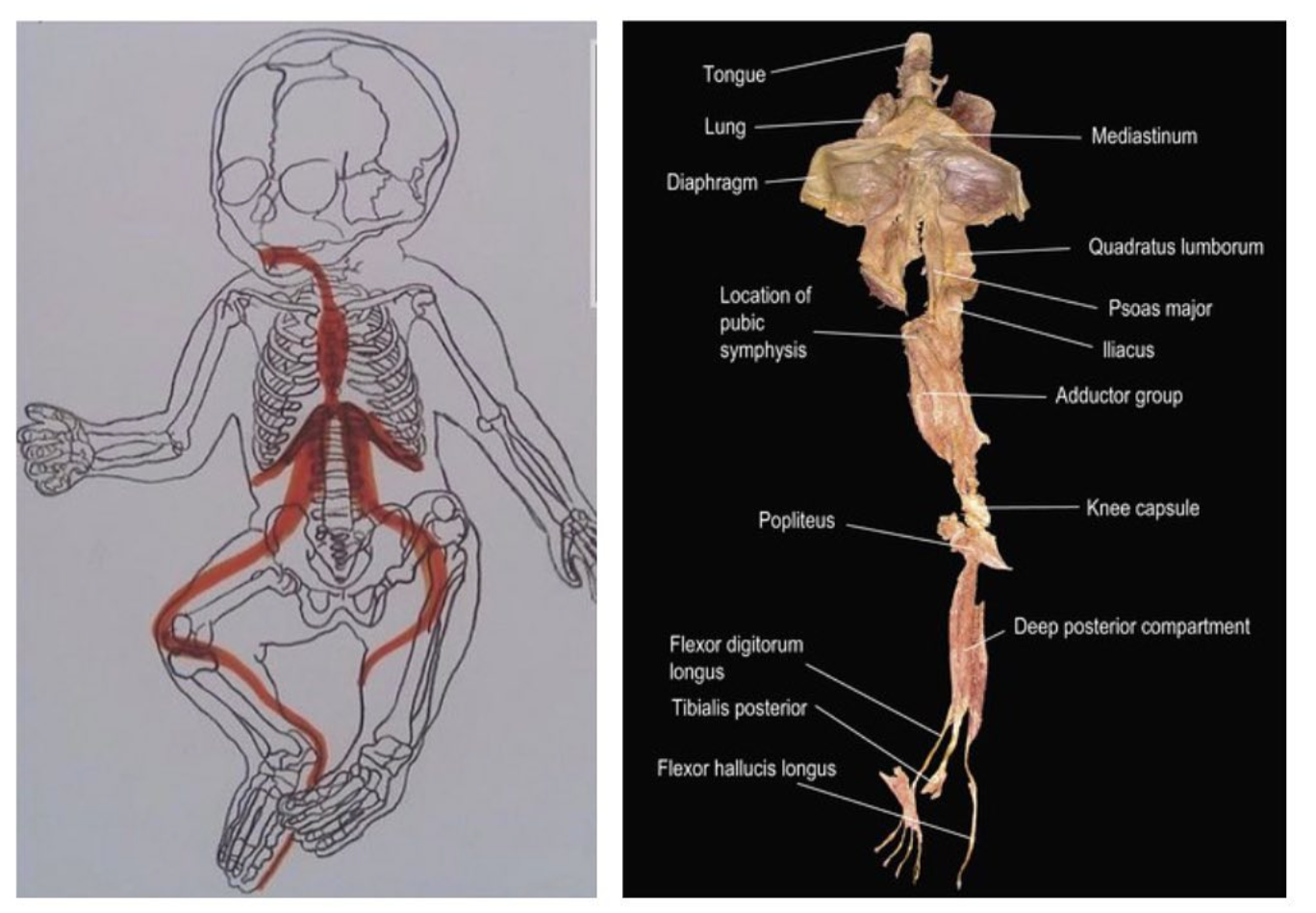
Deep Frontal Line Fascial Connection - Tongue to Toes
This video by Timothy King with Allied Health Focus on YouTube explains this connection and it’s effects really well! View discretion is advised, cadaver images and videos are shown.
I wanted to help my babies open up their body and not be stuck in a collapsed state - especially as they grew. I wanted them to be able to use their body and mouth’s full range of motion to hopefully avoid a lot of problems later in life.
Here’s what I did (or still do) to help my babies develop an open posture:
Frequent Tummy Time
Limited time spent in baby containers
Floor time as much as possible
Breastfeeding in open posture positions like “Koala Position”, “Laid Back”, and “Side-Lying”
Lots of time outside
Bare feet everywhere (or flexible, wide toe-box shoes like these if needed)
And the most important one (in my opinion)…
Releasing tension in the body through Professional and daily At-Home Bodywork
The reason I believe bodywork is so important is because it helps to release tension in the body and supports the nervous system. Released tension and a healthy nervous system are the building blocks to maintaining open posture because it gives the body the freedom of movement it needs to develop properly. Fascial bodywork is my favorite because our fascia surrounds every nerve, bone, muscle, ligament, and organ in our bodies. If fascia is tight, that tension can pull us into collapse, cause pain, and put our nervous-system into fight-or-flight.
👇Watch this video to see a fantastic visual! 👇
My favorite infant bodywork course that teaches you how to encourage open posture for your baby (and toddlers) through bodywork movements done at home is Emily Swann’s (For the Love of Breastfeeding) Dynamic Infant Movement Course. I purchased it when I had my second baby and still use it every day! It is SO in-depth.
Use my affiliate discount code KNOWNNURTURE to get $112 off.
Primal & Open Posture for Adults
Not only is open posture something that benefits babies - it’s good for adults too. Open posture and moving with open and aligned posture (primal movement) is something that came naturally to people in traditional and tribal cultures from living their everyday lives. Modern society has us hunching over desks, collapsing into giant couches, and living very sedentary lives in general.
Our babies will grow up and do the same if we don’t stop the cycle. They mirror us and it’s important that we model what we want to see in our children (physically, emotionally, and spiritually).
This is what led me to wanting to repattern my own posture. Bowspring has become my personal favorite form of exercise for repatterning my fascia and body. I’ve had so much chronic pain and years of negative symptoms completely resolve just from incorporating Bowspring!
Here are a few short videos explaining what Bowspring is, and busting a couple of myths about certain posture recommendations:
What is the Bowspring movement practice?!?!?! by Paris Latka (Bowspring Instructor)
Bowspring is different than modern postural yoga by Paris Latka
Create a spring in your spine! by Paris Latka
Ditch the linear movement, move in spirals by Paris Latka
Bowspring is a “systems” approach by Paris Latka
Healthy lower back curve vs unhealthy by Paris Latka
Similar Open Posture Resources:
Find your primal posture and sit without back pain: Esther Gokhale at TEDxStanford by Esther Gokhale of the Gokhale Method
Primal Movement by Bam Lionhart
Foundation Training by Dr. Eric Goodman
