

How Do I Know If My Baby Has a Tongue Tie?
Why This Question Is So Hard to Answer Online
If you’re asking whether your baby has a tongue tie (or lip tie), you’re probably already deep in the overwhelm of feeding challenges, sleepless nights, and conflicting advice.
This question often shows up when you feel like something is off, but you haven’t gotten clear answers.
The problem is, most of what parents find online about ties, oversimplifies a complex issue (especially in the Facebook mom groups). Ties are often treated like something that can be diagnosed with a quick look in the mouth by any infant medical professional.
Unfortunately, that can lead to:
Misdiagnosis - “Ties” get released when they might not have actually needed it, or, ties get missed because the provider “didn’t see” a tie.
Minimizing - The promise of a “quick snip and easy fix” with no preparation beforehand or rehab afterwards. Only to be left struggling and wondering why the release didn’t work (ask me how I know).
Incomplete release - Where the tie gets released part of the way, but not fully. Symptoms can continue because technically, the tie wasn’t actually released (common with a “quick snip”).
No support system - The family is often left to figure it out themselves and aren’t given any instructions besides stretching the wound.
It’s no wonder ties are such a highly debated topic.
The Two Biggest Misunderstandings I See Around Tongue Tie
There are two misunderstandings I see repeatedly that keep parents stuck and confused.
#1: “You can diagnose a tie from a photo.”

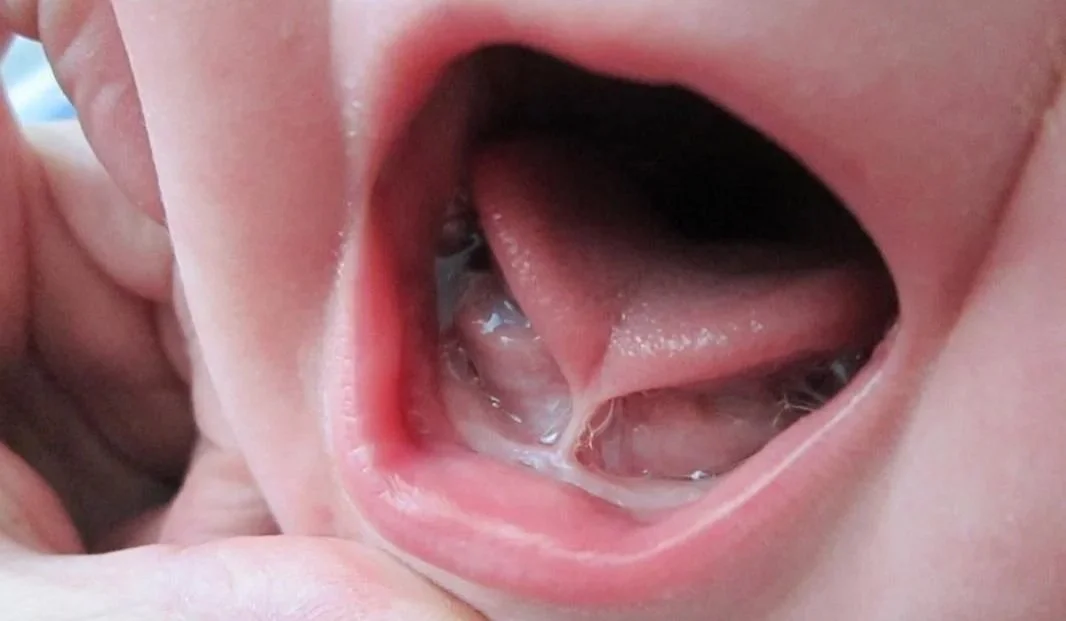
In Facebook groups, I often see parents posting a picture of their baby’s mouth asking, “Is this a tongue tie?” or “Does this look like a lip-tie?”
The truth is: you can’t accurately diagnose a tie from a photo alone. I get it! When you’re struggling, you’re desperate to find answers as fast as possible. But appearance doesn’t tell the full story.
Some babies have very obvious-looking restrictions but feed without issues.
Other babies have no visible restriction and struggle significantly with feeding, weight gain, or comfort.
Photo by Febe Vanermen on Unsplash
#2: “My pediatrician checked and said there’s no tie.”
The other common experience is parents being told there is no tongue tie, or that it is “mild,” but they’re given no other explanation or support for their baby’s symptoms. So many are told “just wait it out".
The problem is not all pediatric providers are trained to assess oral function or look at the whole picture.
Just like you’d want to see a specialist for a heart issue, you want to see a specialist who has the proper training to do a functional oral exam and whole body assessment to see how your baby’s mouth, body, and range of motion is being affected.
What Actually Matters: Function Over Appearance
When I talk with mothers navigating these concerns, my first two questions are always:
Has a functional oral exam been done by a provider who specializes in infant oral function?
Has a whole body assessment been done to check for tension?
That shift alone changes everything.
What matters most is not just what the tissue looks like, but how your baby is functioning.
Red Flags That Something May Be Going On
🚩🚩🚩
These symptoms send a little red flag up in my brain when a parent is wondering if ties could be part of the picture:
This isn’t an exhaustive list, but some of the most common symptoms.
Painful breastfeeding that doesn’t resolve with position change
Difficulty achieving a deep latch
Using a nipple shield and can’t wean off
Clicking sounds or milk dribbling during feeds
Lip blisters
Recessed jaw
Reflux symptoms that don’t improve with diet changes
Baby on reflux medications but they aren’t working (meds mask the symptoms - not resolve them)
Frequent popping on and off the breast
Crying, arching, or distress during feeds
Poor or inconsistent weight gain
These symptoms don’t automatically mean a tie is present. But they do mean it’s worth looking at oral function and feeding mechanics rather than waiting it out.
My Experience With Tongue Ties (and Why This Changed How I See It)

My own journey with ties started with my first baby in early 2021. At birth, our provider checked her mouth and told us there was no tongue tie, but there were red flags from the start. I just didn’t know they were red flags.
She couldn’t latch without a nipple shield - I tried weaning off it multiple times. She was fussy all of the time and took forever to settle. She spit up frequently and seemed to always be in pain. Feeding sessions were long and unpredictable. She would fall asleep at the breast, only to wake shortly after, hungry and screaming again.
The pandemic was still in effect, limiting access to in-person support, so I did what most new mothers were doing at the time - I googled everything. The biggest struggle was not knowing what to search for to get the answers I needed.
When I googled her symptoms, all that came up was “colic” and that we would just have to wait it out. There was the occasional article suggesting to cut out dairy (which I did for weeks and it didn’t help).
Eventually, I found information about ties. I ignored it as a possibility at first because she had already been checked and there weren’t any. But the more I read, the more everything started to make sense. The symptoms lined up in a way I couldn’t ignore anymore.
When I finally got an appointment with our pediatrician, I asked them to check her for ties.
They identified a “hidden” or posterior tongue tie, a lip tie, and cheek tie!
We got them all released the next day.
I expected immediate relief. It didn’t happen.
Weeks passed and feeding was still difficult - all the symptoms were still there. That was one of the hardest parts emotionally—feeling like we had hope, but then not seeing a change.
It was back to square one. I had gotten my hopes up and was about to give in a wait it out.
When my daughter was around four months old, I learned something that completely changed my understanding of the situation: the whole body matters.
I learned that ties affect the entire body and can cause a lot of tension.
I learned about bodywork for babies and how it works with the fascia and the nervous system.
We had tried chiropractic care early on without success, but this time I explored a different type of bodywork and found a Bowen Therapist.
The session was extremely gentle and short, but the change afterward was undeniable. My daughter became calmer, more settled, and feeding began to finally improve in a real, lasting way.
That experience shifted my entire perspective. Ties are rarely just about the mouth. It’s about how the whole body functions together.
🔎🔎🔎
What Kind of Provider to See for Ties
My goal is to help you understand what a good evaluation actually looks like so you can find the right kind of providers to support you along the way.
If your baby is experiencing symptoms, the most important step is not to confirm or rule out a tie based on how it looks or what someone told you.
It’s to find a provider who understands infant feeding and oral function. If you're unsure where to start, my guide can help you find the right provider for your baby's specific needs, including IBCLCs, SLPs, PTs, OTs, holistic bodyworkers, and tongue-tie release providers - worldwide, along with options for virtual support.
The key is not the title alone, but the depth of training.
What a Functional Oral Exam Looks Like:
Not for at-home diagnosis, but for you to be educated on what a provider should be doing. More Oral Motor Support videos here.
oral motor and tongue tie assessment. Special thanks to LALactation for permission to share her videos.
What to Ask When You’re Looking for the Right Provider
Because not all providers assess tongue tie the same way, it is important to ask questions.
One of the biggest challenges is knowing which providers have additional training in infant feeding, oral function, and tethered oral tissues. If you're feeling overwhelmed by the search, I put together The SOS Infant Feeding Directory™ to help you find qualified IBCLCs, bodyworkers, feeding support, tongue-tie professionals, and virtual support options (for when you can’t find local support) without spending hours searching on your own.
Here are a few questions that matter:
✅Do you have additional training in oral function and tethered oral tissues?
✅Do you evaluate feeding function, not just oral anatomy?
✅Do you look at the baby as a whole, including body tension and positioning?
✅Do you have providers you collaborate with (like bodyworkers and release providers)?
✅Do you have a process for deciding if a release is necessary?
✅What does preparation and rehab look like in your office?
A thorough assessment should go beyond what the tongue looks like. It should evaluate how your baby moves, feeds, coordinates, and compensates. You should be given a plan and not feel rushed in any way.
A Different Way to Think About Tongue Tie
One of the most important truths I want you to know is this:
Some babies have what looks like a very obvious tie, but they are able to function without issue. Others have no visible tie and struggle significantly.
That is why appearance alone will always be misleading.
What matters most is function, feeding, and the lived experience of both baby and parent.
If you take nothing else from this, let it be this:
Find someone who knows how to look at the whole picture and takes your concerns seriously.
*for educational and informational purposes only. not professional or medical advice.
